Kitchen Design: 5 Essential Rules

Create your perfect home designs in 3D
Try it in your virtual home
Be sure your furniture is perfect before getting things real
Designing or renovating a kitchen is a major project. Choosing the shape of the space, placing furniture and appliances, optimizing circulation… There are many questions to ask. Here are 5 rules for top-notch kitchen design!
What kitchen layout should you choose?
The furnishing of a space necessarily depends on its configuration. Before focusing on the rules for kitchen design, let’s review the main possible layouts.
I-shaped kitchen
In this elongated configuration, all kitchen furniture is placed along a single wall. This layout is favored in small homes where maximizing space is essential.
L-shaped kitchen
An L-shaped layout distributes kitchen furniture across two walls. It is a standard configuration that adapts to most homes. For greater comfort and practicality, it is often recommended to add a breakfast bar or even a central island.
U-shaped kitchen
A U-shaped layout is preferred for larger spaces. Here, furniture and appliances are distributed along three walls, perfectly defining the kitchen. Once again, adding a central island can bring real added value, serving as a work surface, dining table, and storage space.
With a 3D HomeByMe solution, it is possible to test these different configurations for an interior. After validating the kitchen layout that best suits your tastes or your client’s, it’s time to move on to the furnishing stage.

What are the 5 essential kitchen design rules?
Before starting a renovation or construction project, it is essential to master certain basics. Here are the main kitchen design rules:
1 – Think about the work triangle
This is a well-known concept among kitchen designers. To optimize the available space, movements between three main zones should be minimized:
- Storage zone (fridge and various cabinets)
- Cooking zone (hob and oven)
- Cleaning zone (sink and dishwasher)
For a “perfect” configuration, the distances between each of these zones should be as equal as possible. In short, the goal is to avoid long, unnecessary trips between the main activity points of the kitchen.

2 – Plan the clean and dirty workflow intelligently
The daily life of a kitchen revolves around two main activities: making a mess and cleaning up! It is therefore essential to design the clean and dirty workflow carefully. Specifically, this involves:
- Easy and quick access from the countertop to the trash and sink or dishwasher
- Proximity between the drainer, storage spaces, and the sink or dishwasher
These details improve functionality and everyday comfort. The HomeByMe 3D planner is a valuable tool to design this workflow. In a few clicks, you can add, move, modify, or remove kitchen elements. You can then move freely in the room using the 360° view option to assess the relevance of your kitchen layout.

3 – Measure the available space
Among the kitchen design rules, accurate measurement is essential. Remaining free space is a crucial element that is often overlooked.
When designing the kitchen plan, consider details such as the oven or dishwasher door size. Since the kitchen is a place for movement and gatherings, it is important to plan circulation carefully!
Tip: opting for a storage unit with sliding doors is an excellent way to save space easily.
4 – Don’t neglect lighting
Even a closed kitchen often has a window, but this does not always guarantee sufficient natural light. It is therefore essential to install lighting in key areas:
- Center of the room with a ceiling light
- Cooking area with a hood that has lighting
- Different work zones with directional lighting
For an open kitchen, it may be wise to harmonize the lighting with the living room.
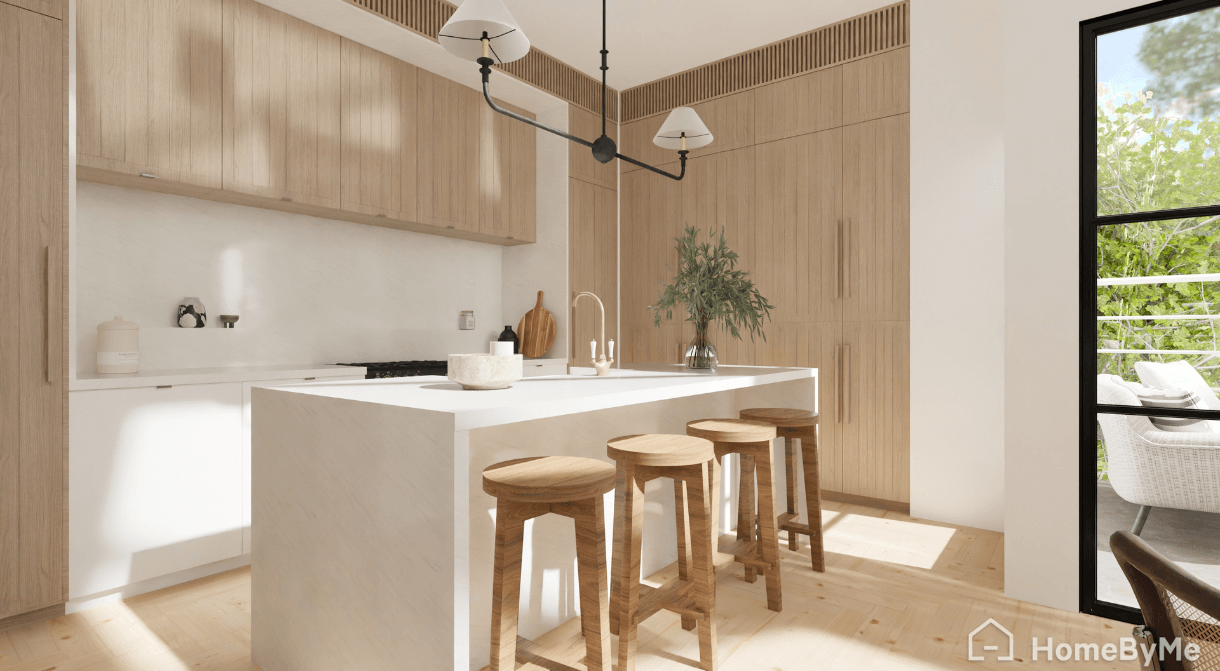
5 – Respect furniture height
Finally, it is important to respect the height of worktops and appliances. Standard heights exist for most furniture elements:
- Between 85 and 95 cm for the worktop
- Between 110 and 120 cm for a bar
- Maximum 220 cm for the handle of the tallest cabinet
The HomeByMe 3D planner allows you to measure these elements to create a functional kitchen. The furniture catalog also shows the dimensions of each product to help you better project yourself into the kitchen to create or renovate.

How to organize a kitchen with the HomeByMe 3D planner?
Now that you know the rules for kitchen design, you need to know how to apply them. Using a design software like HomeByMe allows you to create 3D plans and project yourself in the home accurately. Here are the steps to get started with organizing a kitchen:
7 steps to organize a kitchen
1 Start a new project
Log in to the site and click “Create Project.”
2 Complete the main information
Indicate the type of home, its dimensions, etc.
3 Draw the floor plan of the house
You can draw the walls yourself or import the 2D plan into the software.
4 Arrange the different rooms
From the “Creation” tab, add or remove doors, windows, and partitions.
5 Furnish the interior
From the “Furnish” tab, choose from numerous generic furniture pieces or major brands.
6 Decorate the home
Paintings, lights, plants… Enjoy decorating in the “Decorate” tab.
7 Compare multiple versions
You can create multiple projects for free, so feel free to test different ideas!
Knowing the main rules for kitchen design is essential before starting a project. It guarantees an optimized, functional, and comfortable space, adapted to everyone’s needs and preferences. Island kitchens, glass-panel kitchens, closed or open kitchens… HomeByMe adapts to all desires: modern kitchens, functional kitchens, space-saving solutions, small spaces, while respecting the work triangle.


Create your perfect home designs in 3D
Try it in your virtual home
Be sure your furniture is perfect before getting things real
Design your kitchen now!
